Who Tunes the Harness
For a century, alignment in large companies could only happen after the work was finished. AI moves it inside the work. By pushing alignment into the harness — the shared context every model runs on — orgs can align the output while it is still being made. Coordination, the thing big companies are worst at, becomes close to free. But the same harness that pulls everyone together can grind down the person who breaks ranks — the one whose misaligned but correct bet would have saved the company.
The hardest problem in a large company was never the work. It was getting everyone to do the work in the same direction.
Every method we have typically engages after the work already exists. You let it take shape, look at it, and tug it back toward where it should have been heading. The making of the work lived inside one person's head, unreachable until it surfaced as a finished thing — so the finished thing was the only place alignment could happen. This worked fine while work was slow and correction could keep pace with drift.
AI breaks both conditions at once. It speeds the work up until correction/alignment can't keep pace, and it pries open an opportunity to bring alignment earlier in the loop — into the process of producing the work.
Right about the person, silent on the org
AI makes execution cheap. When a model can draft the contract, write the code, build the deck, run the analysis, the work shrinks to the part only a person can do: deciding what to make, what to kill, what to change. Dan Shipper calls this the allocation economy — everyone turns into a mini-CEO, spending the day directing instead of producing.
For one person, that is close to pure upside. But the trouble starts when you run a whole company this way. A hundred people each aiming a model at whatever sits in front of them, held together only by top-down observe-the-work alignment, will drift. Not wildly. Maybe ten percent off on any given call. But ten percent compounds across a dozen people over a few months, and a stack of locally sensible decisions carries the work somewhere no one chose to go.
At fewer than twenty people this barely registers. You coordinate by talking — same room or same thread, everyone half-aware of what everyone else is doing. At fifty it becomes the whole problem. No one sits in every conversation. The small divergences stack. Output climbs. But whether it adds up to anything is unclear until the quarter is already spent.
After-the-fact was never the flaw
None of this is new. Coordinating people is the oldest problem in management. The org chart, OKRs, the weekly sync, the code review, the design crit — a century of mechanisms for keeping everyone pointed the same way. So what does AI change?
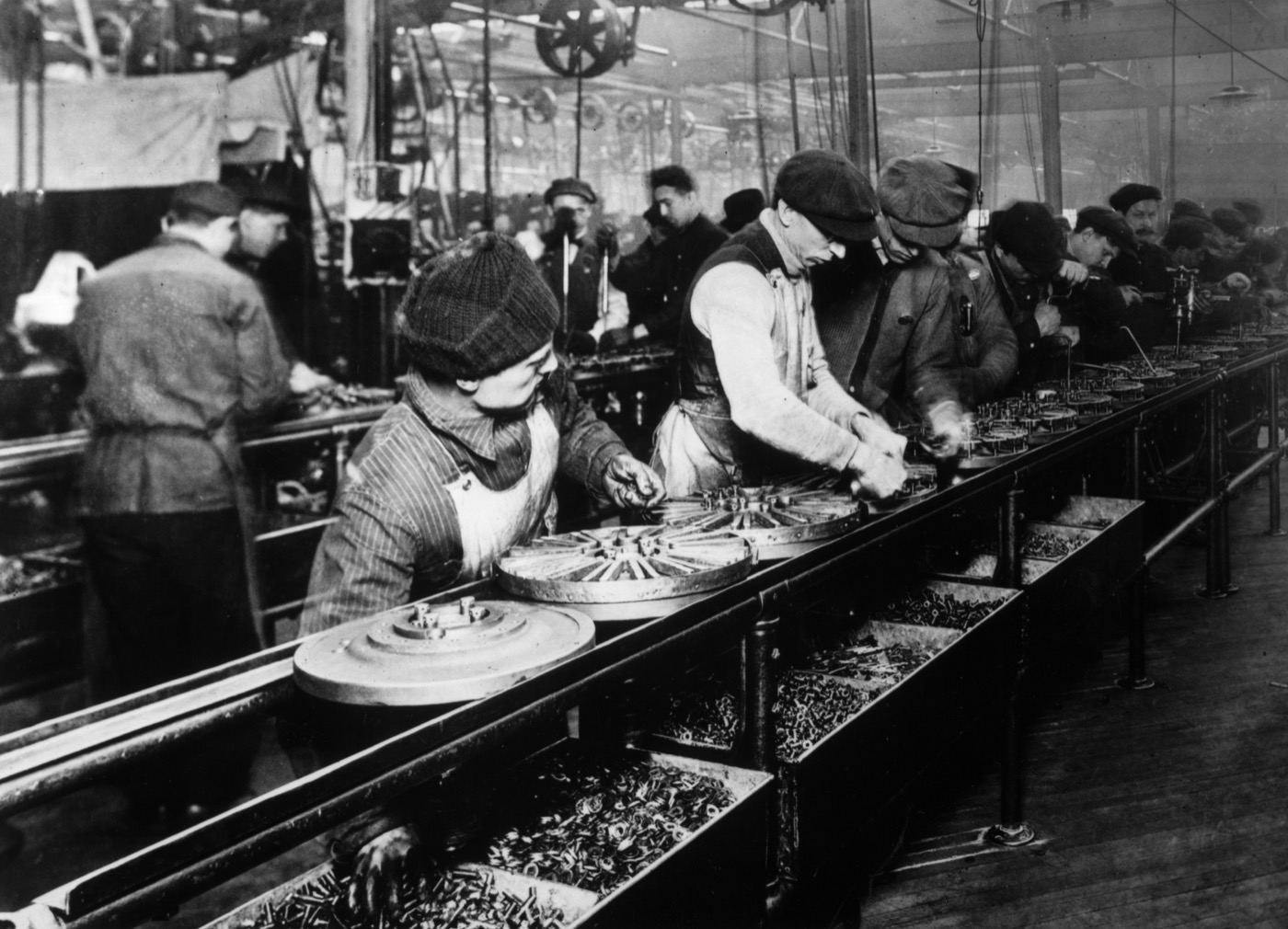
FIG.01 — Ford's first assembly line, 1913. It could line up every pair of hands in the building — and the thinking behind them stayed out of reach for another century. [src]
![[src]](https://en.wikipedia.org/wiki/File:Ford_assembly_line_-_1913.jpg)
Well, look at when those alignment mechanisms used to engage. Every one of them observed an output: a memo already written, a draft already built, a branch already pushed. None of them ever reached the work while it was being made, because the making was unreachable. That was a constraint, not a choice. And this was ok, because work was slow enough that reviewing the output could keep pace with the drift the work introduced.
AI makes this old way of alignment intractable. When everyone produces at several times the old rate, after-the-fact alignment forces a choice with no good side. Inspect every output closely enough to catch the drift, and the review process becomes the bottleneck — you hand back the speed AI just gave you. Skip the inspection to stay fast, and drift compounds across more work than anyone can track. Top-down alignment lives in documents and meetings, and documents and meetings can only sit at the end of the pipe. The faster the pipe runs, the worse both options get.
AI turned the monologue into a conversation
Getting useful work from a model means thinking out loud to it — explaining what you are trying to do, what "good" looks like, why this and not that. The internal monologue that used to stay locked inside your head is now typed into a box, on the record, while the work is still soft.
That act of commiting one's thought process to a conversation makes it shapeable. The organization no longer needs to wait for the finished deck to tug it back into line. It can shape the conversation that produces the deck — the context the model works from, the bar it works against — and steer the work before it sets.
The scaffolding around that conversation has a name: the harness. The knowledge base the model draws on, the system prompt it runs under, the guardrails that keep a line of work sound before it hardens. Shape the harness and you shape the work before the work exists. Reviewing the finished output doesn't disappear — you still check the result — but it becomes a lighter, second pass, because most of the drift got caught upstream where catching it was cheap.

FIG.02 — The harness, from where the driver stands. Adjust the lines and the whole team turns mid-stride. [src]
![[src]](https://en.wikipedia.org/wiki/File:Driver_View_with_Team_on_Wonder_Lake_(7065277547).jpg)
Martin Fowler's team writes about context anchoring — keeping the decisions that matter in a living document instead of a vanishing chat. Ardoq argues a leader's real job is becoming the architect of the company's shared context. The consensus is that this context layer is the new moat: whoever builds the richest, best-kept version wins.
The alignment that was never possible before
This is bigger than catching drift early. Put the strategy into the harness and it is present the entire time the work is made — in every conversation, for everyone using the model. The output comes out aligned because producing a misaligned one would mean working against the grain. Getting hundreds of people to pull the same way is the thing large companies have always been worst at. This is the first tool that makes it close to free.
One caveat, and it matters. A harness only spreads the alignment you give it. Aim it at a muddled strategy and it spreads the muddle — faster and more evenly than before, because AI amplifies what is already there. Deciding what is worth aligning around stays exactly as hard as it ever was. The harness only makes the spreading cheap.
It also dissolves a paradox people keep noticing in AI-native companies: how they stay so flat and so coordinated at once. The flatness is real — few managers, every person running their own surface, moving faster than a larger rival can convene a meeting to respond. The coordination doesn't come from managers checking work. It comes from the harness everyone builds through. A shared, editable layer has quietly taken over the job the management hierarchy used to do after the fact.
The harness has to stay alive
A shared layer that steers everyone carries a weakness the old hierarchy didn't. It is only as good as what's inside it, and what's inside it rots. Old notes pile up. Last quarter's priorities sit there looking current. Strategy keeps moving underneath — a competitor's move can make a plan that was right in March wrong by June — and a harness that doesn't move with it will steer everyone, with flawless consistency, toward a place the company has already left.
So it can't be a broadcast pointed down and left to set. The conversations running through it are the richest signal a company has about where its strategy is thin — every place a person and a model had to argue their way to an answer marks something the strategy didn't already cover. Strategy shapes the work on the way down. On the way back up, the work reshapes the strategy. Keeping that loop live, in both directions, is the real job.
Which raises the question the harness can't answer about itself: whose job is it? Is keeping it honest one person's work or a team's? Is it edited quietly, or versioned in the open and argued over like code? It sits between management and engineering and belongs to neither, and no org chart has a seat for it yet.
The right to pull the other way
This shaping of the harness is the crux. The same harness that pulls a company together could block the move that has saved companies from themselves more than once: the deliberately misaligned bet. When Ken Kutaragi pushed Sony to build the PlayStation, most of the board wanted it dead — a serious electronics company had no business making toys, and games were beneath the brand. It survived because one executive overruled the room, and it went on to become the most profitable division Sony had. That is the shape of the thing: someone reads the roadmap as wrong and builds the other thing anyway, and the bet pays off precisely because it ignores a blind spot the strategy couldn't see — the strategy was the blind spot. Going against the grain is how companies change direction, and an inflexible harness aimed at today's strategy grinds that rebel down with the same machinery that keeps everyone else in line.
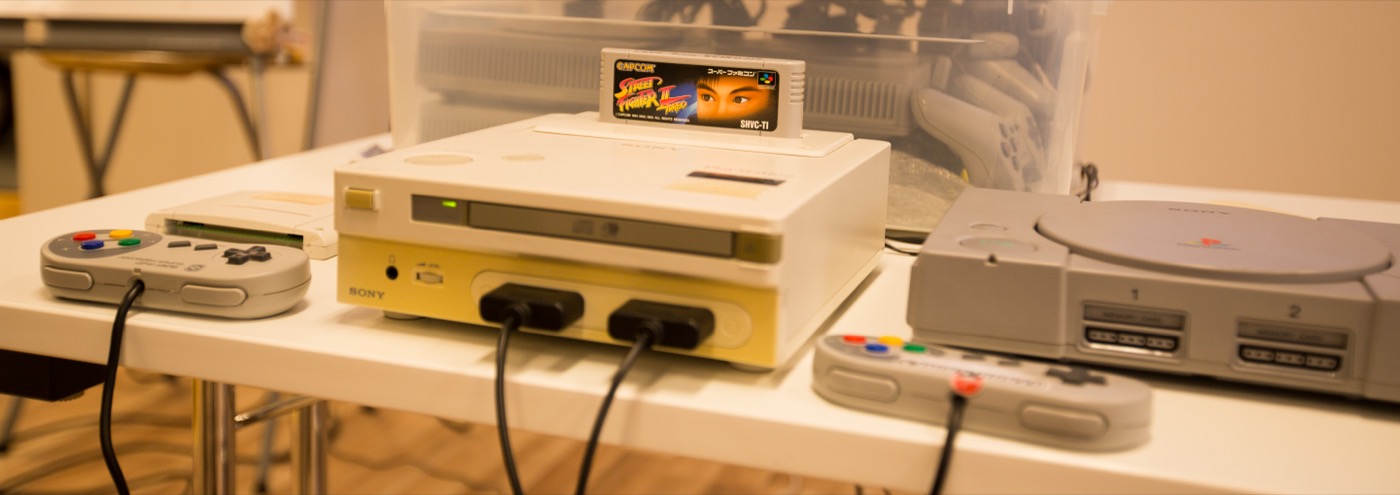
FIG.03 — The PlayStation began life as this — a Nintendo accessory, one of two prototypes still known to exist. When Nintendo walked, Kutaragi turned the wreckage into the machine beside it. [src]
![[src]](https://en.wikipedia.org/wiki/File:Nintendo_Playstation_Prototype_(26398118438).jpg)
Tuning the harness is mostly imagined as maintenance — keeping the contents current. The harder problem is keeping it open: holding room for someone to be wrong on purpose, inside a system built to make everyone right the same way. Getting a company to pull together is about to get cheap. Protecting the person who pulls the other way is the part no one has designed yet.