Would We Still Paint If AI Painted Better?
Weavers in Bengal once wove the finest fabric in the world — Dhaka muslin, so light the traders called it woven air. Then Britain mechanized its looms. Within a few decades the industry was gone, the weaving towns had emptied, and a region that had been one of the richest places on earth was poor.
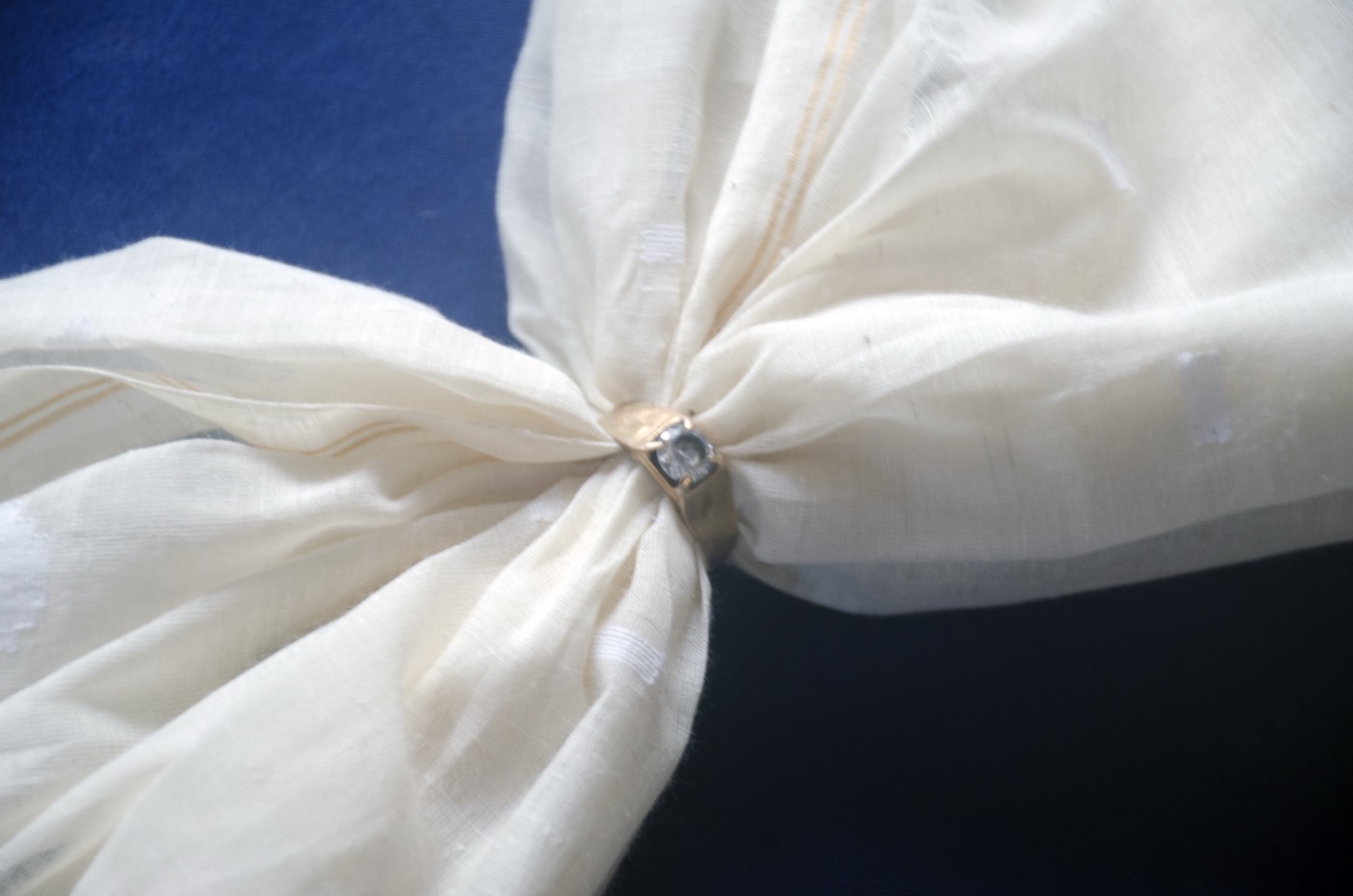
FIG.01 — An entire length of fine Bengali muslin, pulled through a single finger ring — the buyer's test for what the traders meant by woven air.
![[src]](https://en.wikipedia.org/wiki/File:Moslin_1.jpg)
[src]
The textbooks treat this as a chapter about colonialism. It is. But inside that chapter sits a question AI has made personal for all of us: what happens to people whose craft a machine learns to do better?
This already happened to the weavers
Dhaka muslin had thread counts between 800 and 1200. Most fabric sold as muslin today sits between 40 and 80. The technique was so specialized that when the weavers stopped, the knowledge stopped with them — nobody alive knows how to make it, and even the specific cotton plant used to create it went extinct.
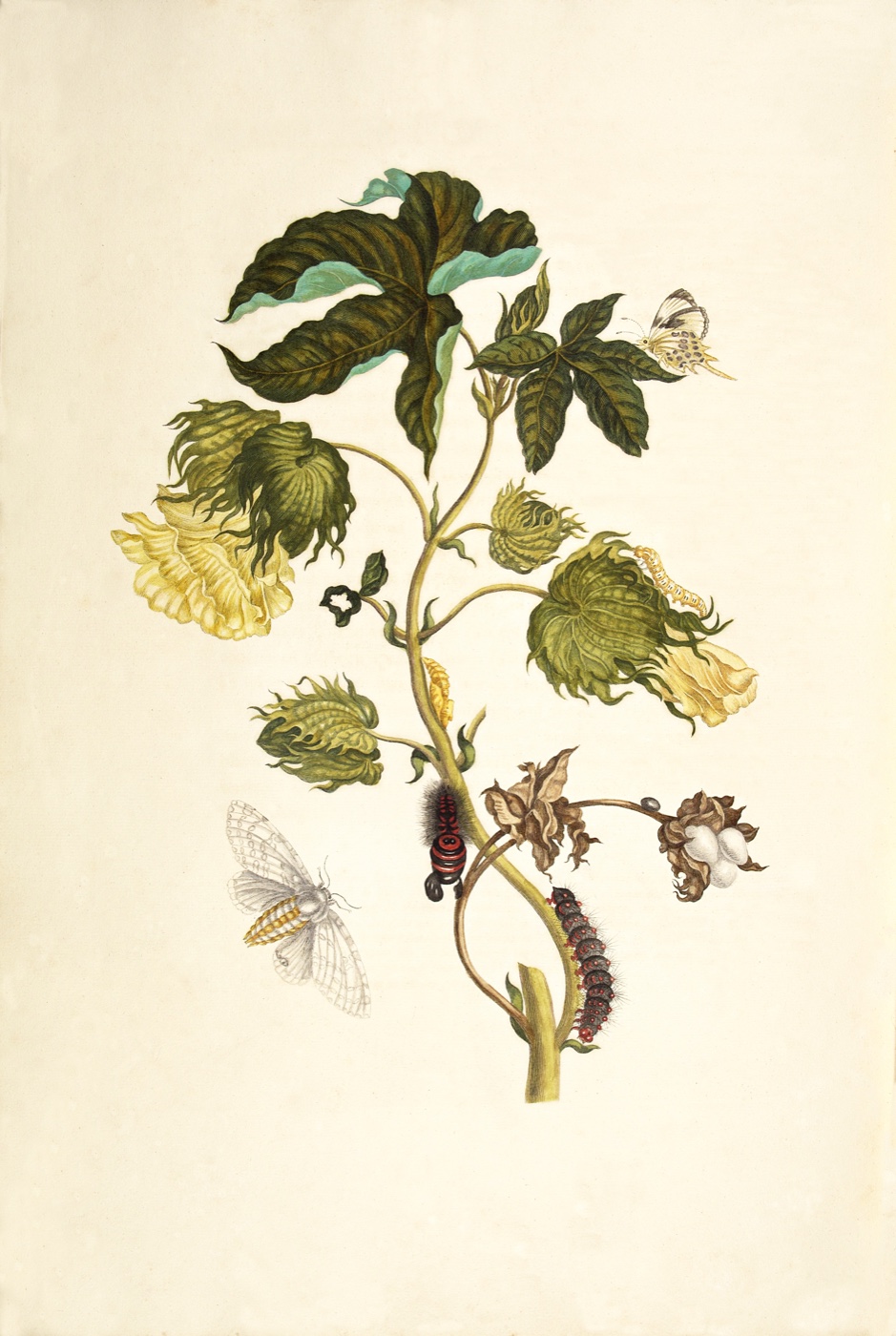
FIG.02 — Tree cotton, painted by Maria Sibylla Merian in 1705. The muslin weavers' own cotton — Phuti karpas — grew along one stretch of Bengal river and died out alongside the trade; Bangladesh is only now breeding it back.
![[src]](https://en.wikipedia.org/wiki/File:Surinaamse_cattoen_boom_Maria_Sibylla_Merian_1705_plate_X.png)
[src]
The speed of the collapse is documented. In 1811, cloth imported from Britain made up a quarter of Bengal's textile market. By 1840 it was 93 percent. Dhaka, the center of the trade, fell from around 200,000 people in 1801 to about 51,000 by 1840 — a city built on cloth, emptied out within one working lifetime. The ruin produced the line the textbooks still quote, attributed to Governor-General William Bentinck: "The bones of the cotton-weavers are bleaching the plains of India."
It is tempting to read this as a story about empire, and partly it is. The East India Company forced weavers to sell only to its agents, at prices it set. Bengal's cotton exports carried a 75 percent duty. Indian cloth entering Britain was taxed at 70 to 80 percent, while British cloth entered India nearly free. The market was rigged, and historians still argue over how much of the collapse was the rigging and how much the machine itself.
But there is a comparison closer to a control. Britain had its own hand weavers, with no empire working against them and no Company agents, and they were ruined too. At the trade's peak there were around 240,000 handloom weavers in Britain, and their weekly wage fell from about 20 shillings in the early 1800s to 5 by the late 1820s. Part of that was oversupply. Cheap machine-spun yarn made weaving easy money for a while, and workers, many of them Irish immigrants, poured in faster than the industry could hold them. Part of it was the power loom, which went from 2,400 machines in 1813 to over 100,000 by 1835. Economists still argue over the mix. Either way the machine set the terms: the same technology that pulled people into weaving then automated it out from under them (vibe coders beware!). Parliament's Royal Commission on Hand-Loom Weavers spent four years documenting the starvation that followed. The Luddites came from these people — weavers and croppers who smashed power looms and earned a name that still means "fool who fears progress."
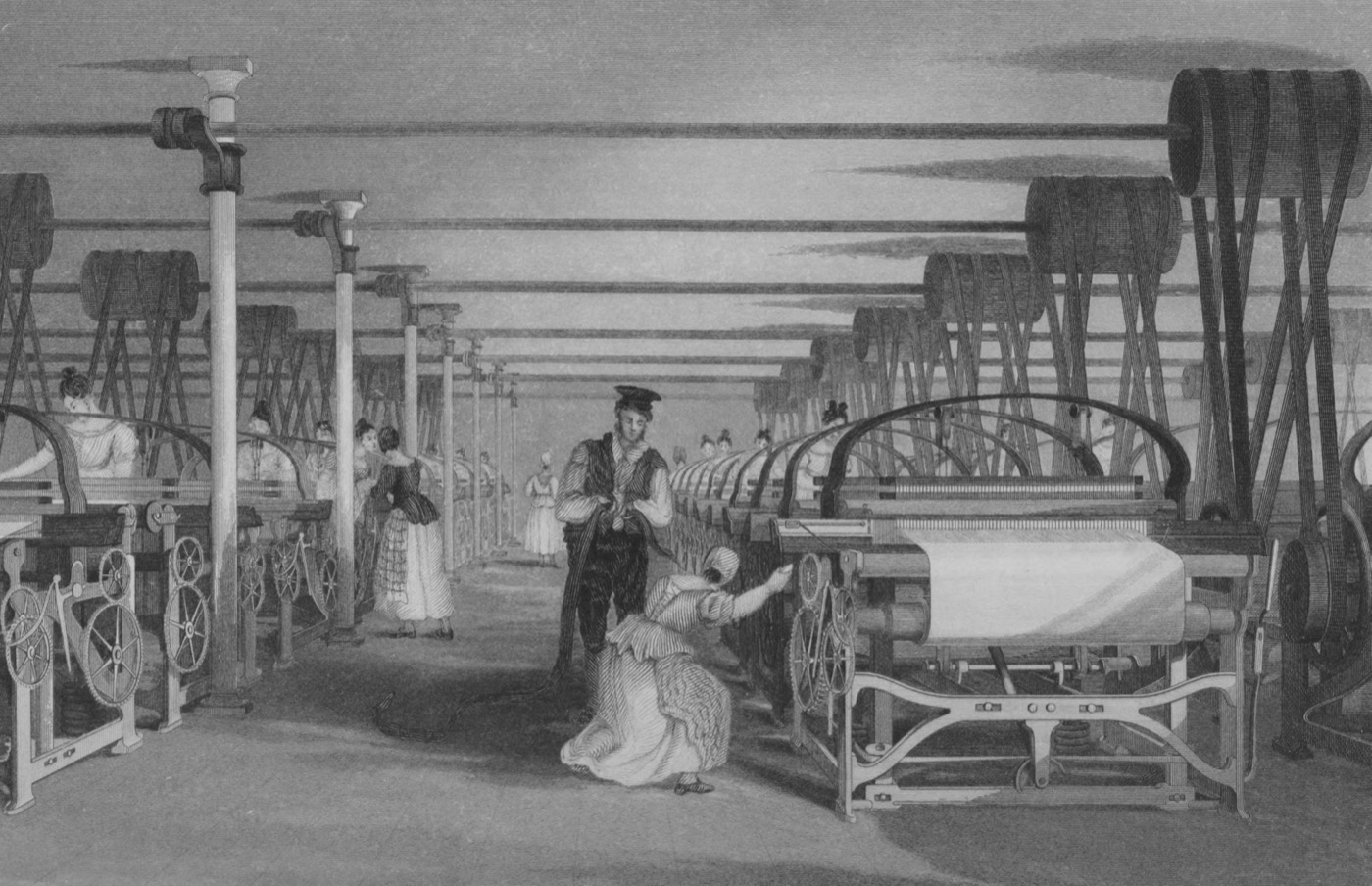
FIG.03 — Power-loom weaving in 1835, the year Britain's count of these machines passed 100,000, up from about 2,400 in 1813. Women ran them for a fraction of what a hand weaver had earned.
![[src]](https://en.wikipedia.org/wiki/File:Powerloom_weaving_in_1835.jpg)
[src]
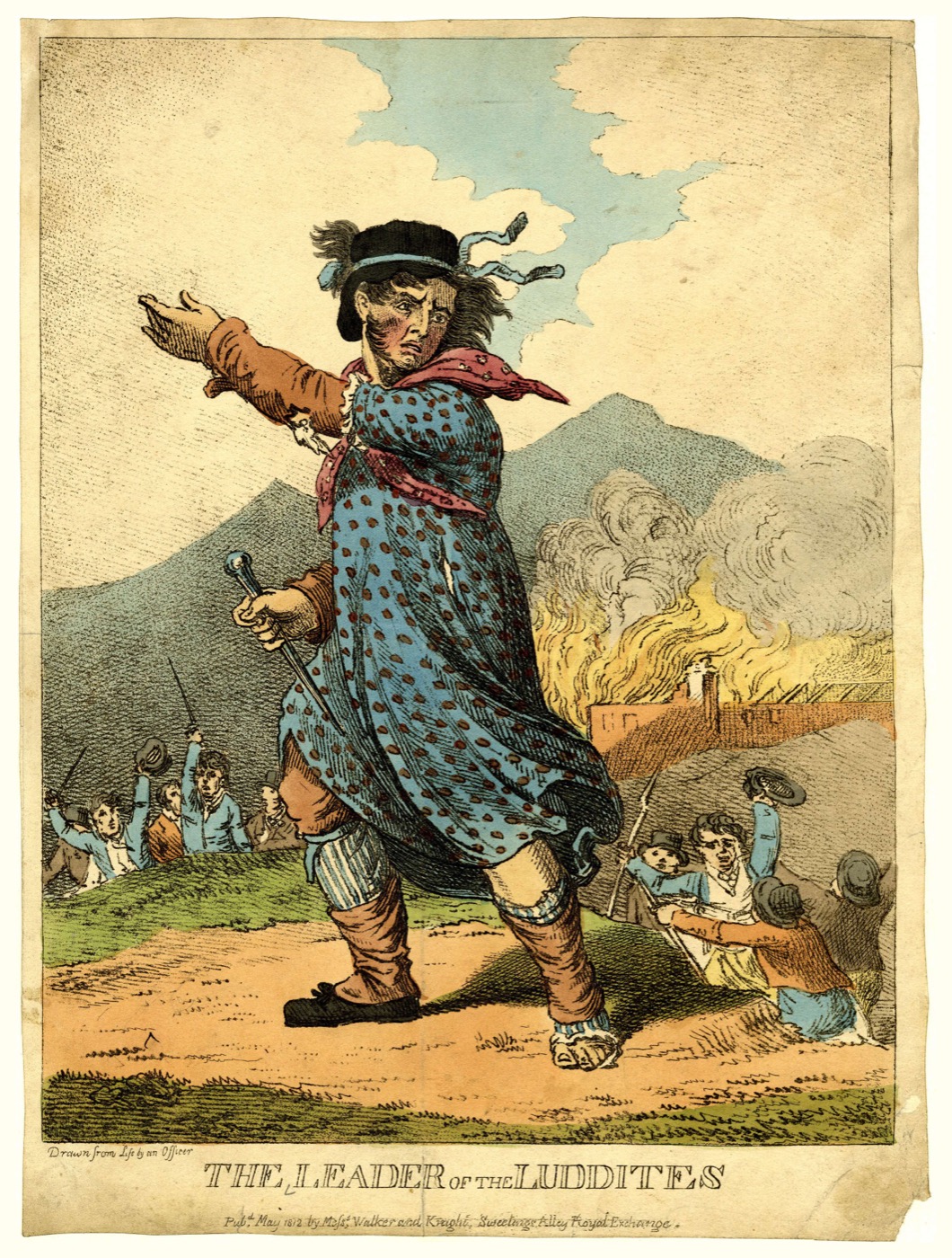
FIG.04 — "The Leader of the Luddites," 1812, drawn as a costumed "General Ludd" with a mill burning behind him. The men behind the name were skilled weavers breaking the machines that had cut their wages — "fool who fears progress" was attached to them later.
![[src]](https://en.wikipedia.org/wiki/File:Luddite.jpg)
[src]
Handlooms are still an industry today, only a much smaller piece of the textile world. A heritage market survives too (cloth that sells precisely because a human made it).
Would we still paint if AI painted better?
Yes, probably. Some painting would survive as a market for human-made work. Some would survive as inheritance, ritual, habit, status, taste. Some would become a hobby. But for most painters, painting would stop being a way to earn a living.
We measure ourselves by what we make
Ask most people in the rich economies what they are and they answer with what they do. The job is the reply. We have built much of our idea of worth around output — around what we produce and the price it fetches.
What happens when AI devalues our output and we lose the market for what we produce? What will happen to our sense of worth? Will it disappear?
I hope not.
There was never one way to be human
If we widen the lens into the distant past, the world we inhabit today — its norms, customs and core values — starts to look like an exception rather than the norm.
I have been slow-reading a book, The Dawn of Everything, over the past year. David Graeber and David Wengrow's seven-hundred-page survey of how humans have organized themselves in the past is not a book about AI.
Its central argument cuts straight at the idea that output was ever the natural measure for our worth. There was never a single way to be human. Some societies worked constantly. Some had enormous leisure. Some reorganized themselves with the seasons — the Plains nations that put themselves under a coercive police force during the summer buffalo hunt and disbanded it once the hunt was done.
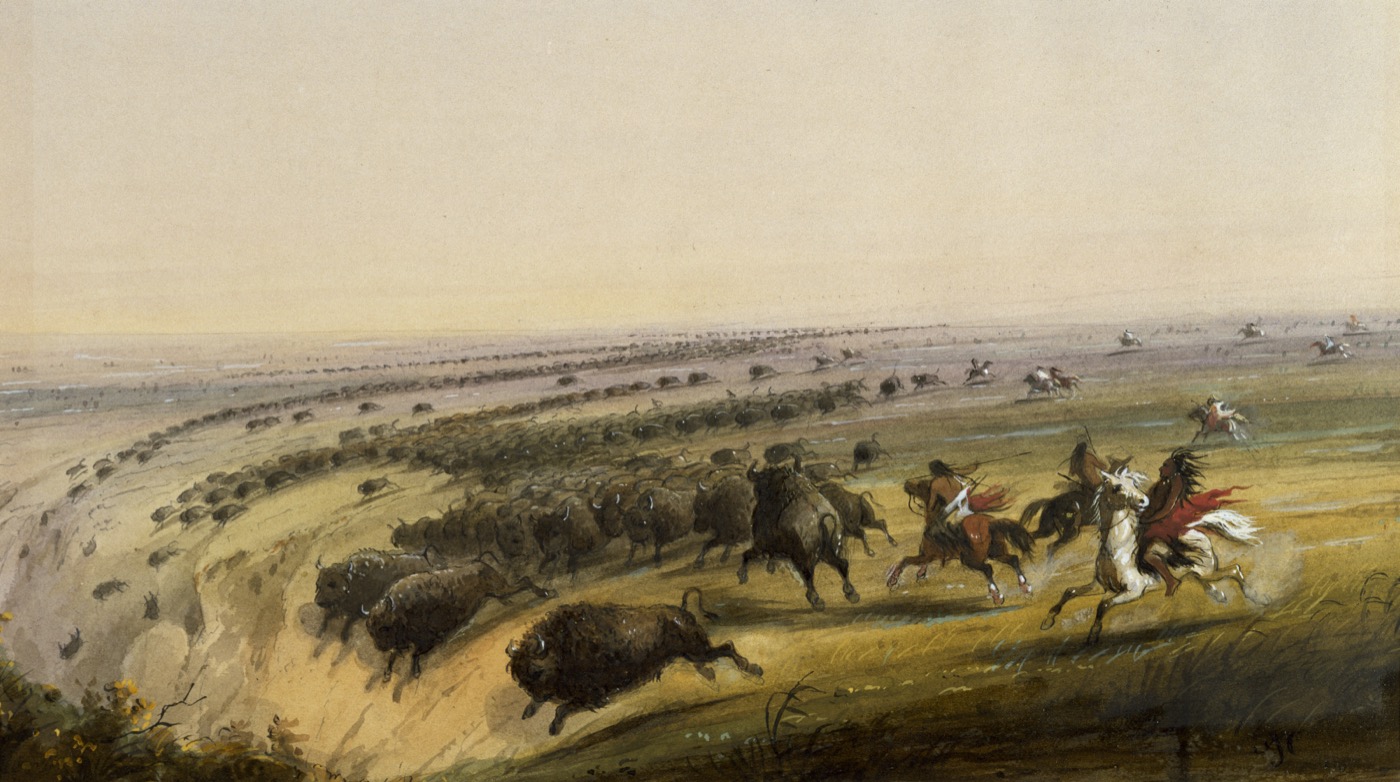
FIG.05 — A Plains buffalo hunt, painted by Alfred Jacob Miller in the 1830s. The summer hunt needed tight coordination, so some nations granted a police society real power to compel for the season and dissolved it once the herd moved on.
![[src]](https://en.wikipedia.org/wiki/File:Alfred_Jacob_Miller_-_Hunting_Buffalo_-_Walters_371940190.jpg)
[src]
Each of these societies anchored a person's worth differently — kinship, ritual, land, God, honor. The arrangement we take for granted — worth measured by output — is one configuration among many.
The first few chapters describe Kandiaronk, a Wendat statesman who debated French colonists in the 1690s. He was not impressed by what they had built. The French, as he saw it, had organized their whole society around money and material life, and it had cost them their freedom — it made them fearful of poverty and cruel to anyone who fell into it. The Wendat valued personal freedom differently. Through his lens, the French mistake was not that they toiled so hard compared to the Wendat. It was that they had let economic life become the measure of life.
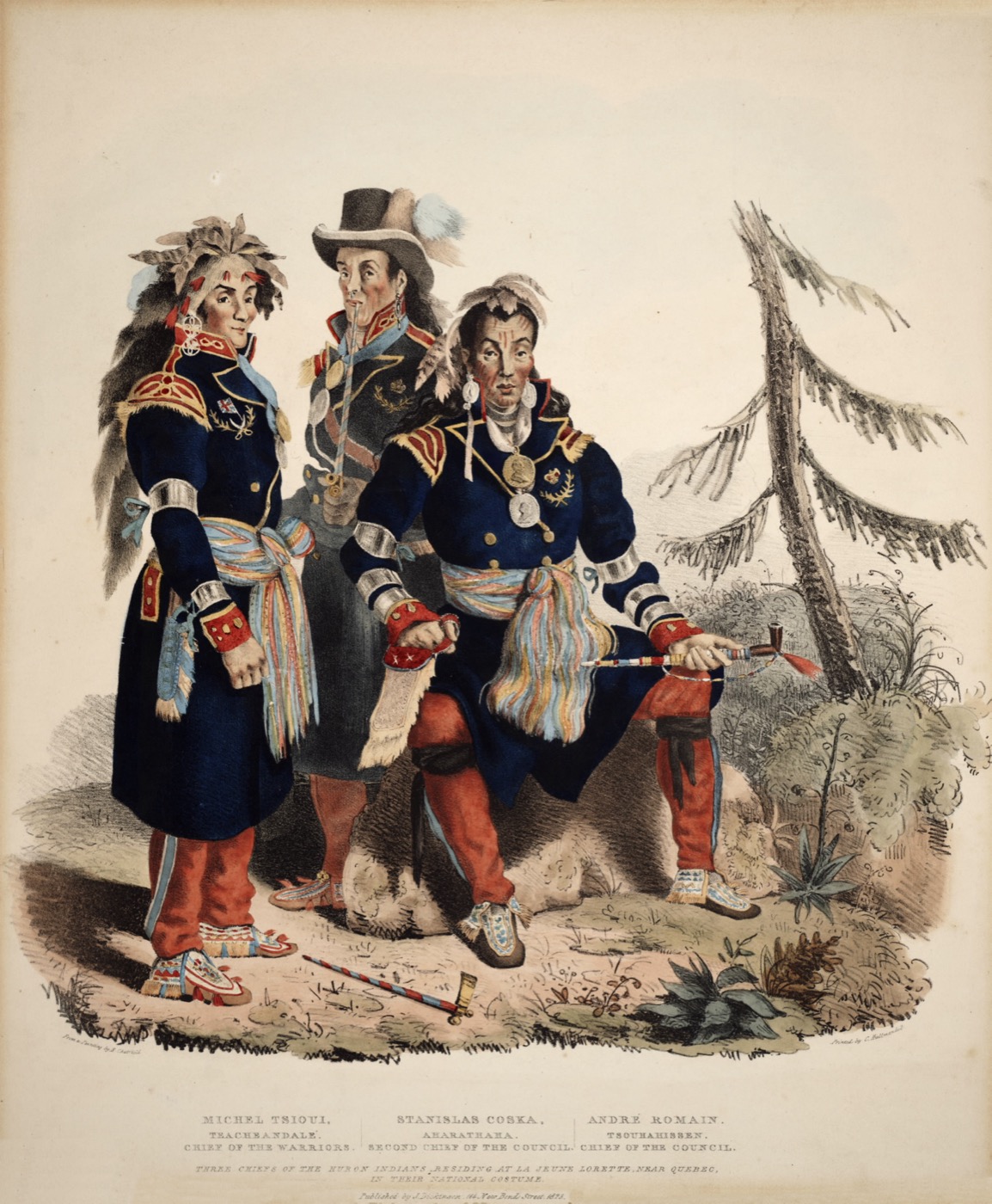
FIG.06 — Three Wendat (Huron) chiefs at Lorette, drawn around 1825. Kandiaronk came from this people; the French thought his arguments sharp enough to write down, and the published versions circulated through Enlightenment Europe.
![[src]](https://en.wikipedia.org/wiki/File:Three_chiefs_of_the_Huron.jpg)
[src]
I am not suggesting the Wendat had the answer, and the book doesn't suggest it either. What it offers is evidence — that selves have been built on foundations other than the market value of what we can produce, and could be again. On freedom, like the Wendat. Or companionship. Or leisure. Or something nobody has tried yet.
There is one constraint every society in the book shared that we might not. Everything in the record, however it organized itself, was built by people who still had to survive. If AI delivers real abundance — and that is one way this could go — the next arrangements get built without that floor. Human curiosity will still exist. So will status, boredom, love, rivalry, taste. A culture untethered from producing to survive could grow unconstrained, into forms nobody can see from inside the present.
The anchor is about to be pulled out
None of this would matter much if the machines stayed where they are. The weavers would be a closed case, two centuries behind us. But many of the people building today's systems expect what happened to that one craft to happen across most kinds of work, and soon.
When AI Impacts surveyed nearly 2,800 AI researchers in 2023, the aggregate guess put even odds on machines doing every task better and more cheaply than human workers by around 2047. The spread was enormous — some said within a few years, some said not this century — but the center of mass keeps moving earlier. I'd treat that as a bet the field is placing, not a fact. The wager is that within a working lifetime, human output stops being valuable.
If that comes true, the anchor goes for the broad middle — everyone raised to be worth what they produce.
John Maynard Keynes saw the shape of this in 1930, before there was a machine to pin it on. In "Economic Possibilities for our Grandchildren," he imagined technology solving the economic problem and handing people a stranger one: what to do with the freedom when necessity stops organizing the day. He did not expect us to take it well. There is "no country and no people," he wrote, "who can look forward to the age of leisure and of abundance without a dread."
Will there be another Picasso?
Say AGI is here. Will we still make things?
Yes. People sing in the car. They cook for people they love, keep gardens that cost more than the vegetables, write novels no one will read. We make things because the making is good, long before anyone pays for it or claps. Take the market out entirely and that does not stop.
The second question is harder. Will we still need to be good?
My hunch is that the market has been the great forcing function for quality. It put a price on human output and set us competing, and a lot of what we admire in human work got that good because there was a market paying for better. The painter studied anatomy because patrons paid for likeness. The weaver counted threads because finer cloth fetched more. Take the market away, and you remove the engine that drove most of that getting-better.
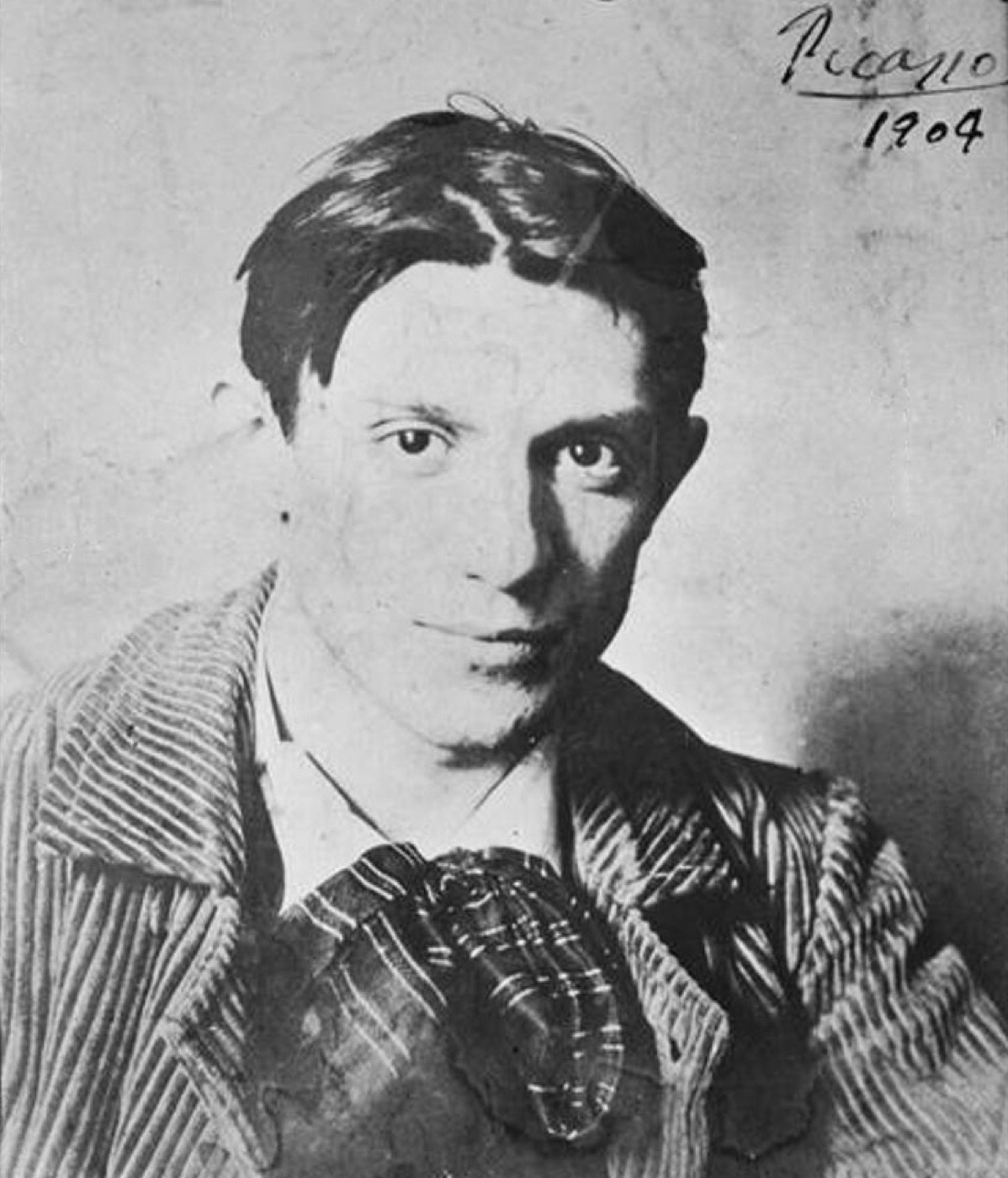
FIG.07 — Picasso in 1904, twenty-two and poor, a year or so before buyers began competing for his work. The years he spent drilling technique were partly a bet that someone, eventually, would pay for it.
![[src]](https://en.wikipedia.org/wiki/File:Pablo_Picasso,_1904,_Paris,_photograph_by_Ricard_Canals_i_Llamb%C3%AD_cut.jpg)
[src]
So here is the question I keep turning over. If no one will pay for the work, why try to get good at all? Maybe the urge to improve was always a bid for someone's eye, and it will fade the moment the eye is gone.
I don't know.
But the question may be the wrong one. The drive to be good never floated free of what a society valued; it pointed wherever the worth was. The Wendat got good at what a culture built on personal freedom rewards — independence, and an eloquence that could win an argument without force, the kind the French colonists marveled at.
We in our world got good at output because output is what ours pays for. Move the anchor — to personal freedom, say, or to standing in a community — and our value system moves with it. Whatever the next world decides is worth having is what we would learn to be good at instead.